game etruesports
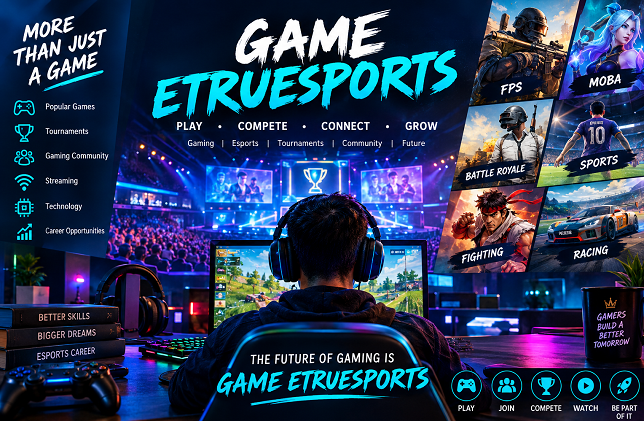
The world of gaming has changed dramatically over the last decade. What was once considered a simple form of entertainment has developed into a massive digital industry involving competitive gaming, live streaming, gaming communities, tournaments, technology, and professional esports. Within this changing environment, game etruesports represents an interesting search topic for players who want to discover gaming content, competitive experiences, updates, strategies, and the broader esports culture.
Game EtrueSports can be viewed as a concept connecting modern video games with the competitive side of gaming. Players today are not only interested in playing games; they also want to follow tournaments, understand strategies, watch skilled players, explore new releases, and stay informed about gaming developments. This combination makes esports-orientated gaming content increasingly valuable to both casual players and dedicated competitors.
Whether someone enjoys multiplayer action games, strategy titles, sports simulations, battle royale experiences, or competitive team games, esports provides opportunities to turn ordinary gameplay into a more engaging experience. This article explores the meaning of game etruesports, its major features, benefits, gaming categories, technology, community culture, and future possibilities.
Also Read: eTrueGames New Games Reviews by eTrueSports
What Is Game EtrueSports?
The phrase game etruesports can be understood as a search term associated with gaming and esports-related content. It brings together two major ideas: games and competitive esports. Games provide the interactive experience, while esports adds organised competition, professional players, tournaments, rankings, teams, and spectators.
Modern esports can involve individual competitors as well as professional teams. Players may compete locally or internationally, depending on the game and tournament structure. Matches can be watched through online streaming platforms, social networks, gaming websites, or event broadcasts.
For gamers, this ecosystem creates several ways to participate. Someone can simply play for entertainment, practise competitively, follow professional matches, create gaming content, or become involved in an esports community. As a result, gaming is no longer limited to sitting in front of a console or computer and playing alone.
Why Game EtrueSports Is Becoming Popular
One important reason for the popularity of game etruesports is accessibility. Modern gaming platforms allow players to connect with people from different countries within seconds. A player with an internet connection can join multiplayer matches, communicate with teammates, and compete against opponents around the world.
Another reason is the growth of gaming content. Players can watch tutorials, tournament highlights, strategy discussions, reviews, livestreams, and competitive matches. This content helps gamers improve while also creating entertainment beyond the actual game.
Social interaction is another major factor. Competitive games often include teams, clans, guilds, communities, and online friends. Players can discuss strategies, share achievements, organise matches, and learn from more experienced competitors.
The increasing quality of gaming hardware has also contributed to the growth of esports. Faster processors, powerful graphics cards, high-refresh-rate monitors, responsive controllers, gaming keyboards, and reliable internet connections allow players to experience increasingly sophisticated competitive environments.
Major Types of Games in the EtrueSports Ecosystem
The esports world includes many different game categories. Each category requires a different combination of skills and strategies.
| Game Category | Main Skills | Competitive Features |
|---|---|---|
| Battle Royale | Aim, survival, decision-making | Squads, rankings, tournaments |
| MOBA | Teamwork, strategy, timing | Professional leagues |
| FPS | Accuracy, reflexes, communication | Competitive matches |
| Sports Games | Timing, tactics, game knowledge | Online competitions |
| Fighting Games | Reaction, combos, prediction | One-on-one tournaments |
| Strategy Games | Planning, resource management | Ranked competition |
| Racing Games | Precision, speed, consistency | Time trials and races |
Each category offers a different competitive experience. For example, first-person shooters often emphasise accuracy and fast reactions, while strategy games may depend more heavily on planning and resource management.
Game EtrueSports and Competitive Gaming
Competitive gaming is one of the most important parts of the modern esports industry. Unlike casual gaming, competitive play often involves structured rules, rankings, scheduled matches, teams, and tournaments.
Players who want to compete seriously generally need consistent practice. Simply playing for many hours does not automatically make someone better. Effective training involves identifying weaknesses, studying gameplay, practising specific mechanics, and learning from mistakes.
Team-based games add another layer of complexity. A highly skilled individual may still lose if the team lacks communication and coordination. Professional teams therefore spend significant time developing strategies, understanding opponents, and improving teamwork.
The Importance of Gaming Strategy
Strategy is central to game etruesports. Competitive players need to understand more than the basic controls of a game. They must learn maps, characters, weapons, abilities, objectives, timing, positioning, and opponent behaviour.
A good strategy can help a player make better decisions under pressure. For example, instead of immediately attacking an opponent, a player might wait for a better position or coordinate with teammates.
Game knowledge also becomes increasingly important as players improve. Understanding the current game environment allows competitors to adapt to different situations.
A useful improvement cycle is:
Play → Analyse → Practice → Compete → Review → Improve
Following this process can make training more effective than simply playing without a specific objective.
Technology Behind Modern Esports
Technology has transformed competitive gaming. Modern esports depends on hardware, software, networking, streaming technology, and digital platforms.
A competitive player may use a gaming PC or console, high-refresh-rate display, mechanical keyboard, gaming mouse, headset, controller, and stable internet connection. Every component can influence the gaming experience.
Network performance is especially important for online competition. High latency can cause delays between a player’s action and what happens inside the game. Competitive players therefore often prioritise stable connections and low latency.
Streaming technology has also expanded esports audiences. A tournament can now reach viewers in many countries without requiring them to attend a physical venue.
Game EtrueSports and the Gaming Community
Community is one of the strongest elements of esports culture. Online communities allow gamers to connect, exchange information, discuss matches, and share experiences.
A healthy gaming community can help new players learn faster. Experienced gamers can provide tips, while beginners can ask questions and participate in friendly matches.
However, responsible behaviour is important. Competitive environments can sometimes become stressful, particularly when players lose repeatedly. Maintaining good sportsmanship, avoiding harassment, and respecting opponents helps create a better gaming experience.
Benefits of Competitive Gaming
Competitive gaming can provide several positive experiences when approached responsibly.
Improved Decision-Making
Many competitive games require players to make quick decisions. Players must evaluate risks, choose strategies, and react to changing situations.
Teamwork and Communication
Team-based games can encourage communication and coordination. Players learn that individual skill is often only one part of winning.
Problem-Solving
Games frequently present unexpected challenges. Competitors must identify problems and find solutions quickly.
Goal Setting
Ranked systems and tournaments give players measurable goals. Moving to a higher rank can provide motivation for structured practice.
Entertainment
Most importantly, games can simply be enjoyable. Competitive gaming combines entertainment with challenge, making matches exciting for players and viewers.
How to Improve Your Game EtrueSports Skills
Improving competitive gaming skills requires patience and consistency. Players should begin by understanding the fundamentals of their chosen game.
First, learn the controls and core mechanics. Next, study maps, objectives, characters, weapons, or other game-specific systems. Once the basics become comfortable, begin focusing on advanced strategies.
Recording gameplay can also be useful. Watching previous matches allows players to identify repeated mistakes. A player might discover that they make poor decisions when under pressure or repeatedly position themselves incorrectly.
Another useful approach is to specialise before trying to master everything. In team games, becoming highly effective with a particular role can help a player understand the competitive environment more deeply.
A Practical Training Routine
A simple training routine can make practice more organised:
| Training Activity | Suggested Purpose |
|---|---|
| Warm-up | Improve reflexes and control |
| Mechanics Practice | Develop accuracy and movement. |
| Ranked Matches | Test skills under pressure |
| Replay Review | Identify mistakes. |
| Strategy Study | Learn better decision-making. |
| Team Practice | Improve communication |
| Rest | Prevent fatigue and burnout. |
The goal is not necessarily to play continuously. Quality practice is often more useful than excessive playtime.
Game EtrueSports for Beginners
New players should not feel pressured to become professional immediately. Competitive gaming has a learning curve, and everyone starts as a beginner.
Start with one game rather than switching between many titles. Learn its basic mechanics and gradually develop familiarity. Play against opponents at an appropriate skill level and use losses as learning opportunities.
Beginners should also remember that rankings do not define their overall gaming ability. Progress can be measured through better decision-making, improved mechanics, stronger teamwork, and greater game knowledge.
Esports Tournaments and Events
Tournaments are a major part of the esports ecosystem. They can range from small community competitions to large international events.
Tournament structures vary. Some use knockout brackets, while others use league formats or group stages. Prize pools, team sizes, rules, and qualification systems also differ between games.
For viewers, tournaments offer an opportunity to watch advanced strategies and learn from professional competitors. Observing high-level matches can reveal positioning techniques, team coordination, and decision-making approaches that casual players may not notice.
The Role of Content Creators
Content creators have become an important part of gaming culture. Streamers, video creators, reviewers, analysts, and esports commentators provide information and entertainment to gaming audiences.
A creator might produce tutorials for beginners, competitive guides for advanced players, tournament analysis, gaming news, or entertaining gameplay videos.
This content also helps build communities around individual games. Viewers can discuss strategies, share opinions, and learn from creators who specialise in particular titles.
Responsible Gaming and Balance
Competitive gaming should remain part of a balanced lifestyle. Spending excessive time playing without breaks can lead to fatigue and reduced concentration.
Players should take regular breaks, maintain healthy sleep habits, stay hydrated, and balance gaming with school, work, exercise, family, and other responsibilities.
Mental health and sportsmanship also matter. Losing a match is normal. Instead of becoming angry after every defeat, players can use losses as opportunities to identify areas for improvement.
A balanced approach can make gaming more enjoyable and sustainable in the long term.
The Future of Game EtrueSports
The future of esports is closely connected to technological innovation. Faster internet, improved graphics, cloud gaming, artificial intelligence, virtual reality, and advanced broadcasting could change how competitive games are played and watched.
Mobile esports is also significant because smartphones have made gaming accessible to a huge audience. Competitive mobile titles can attract players who may not own expensive gaming PCs or consoles.
Artificial intelligence may also influence training and analysis. AI-powered systems could help players identify mistakes, analyse statistics, and understand patterns in their gameplay.
As technology develops, the boundary between gaming, entertainment, sports, and digital communities may continue to become less distinct.
(FAQs): Game etruesports
1. What does game etruesports mean?
Game etruesports is a keyword associated with modern gaming and esports-related topics. It can refer broadly to competitive gaming, esports content, strategies, tournaments, gaming technology, and communities.
2. Is game etruesports only for professional players?
No. Esports content can be enjoyed by beginners, casual players, competitive gamers, viewers, and gaming enthusiasts. You do not need to be a professional player to participate in or enjoy the esports ecosystem.
3. What skills are important in esports?
Important skills include reaction time, accuracy, decision-making, communication, teamwork, game knowledge, adaptability, and strategic thinking. The importance of each skill depends on the game.
4. How can beginners improve their competitive gaming skills?
Beginners should learn the fundamentals, practise consistently, review their mistakes, study experienced players, and focus on improving one skill at a time.
5. Are gaming tournaments important to esports?
Yes. Tournaments provide structured competitive opportunities and allow professional and amateur players to test their skills against others.
6. What equipment is useful for competitive gaming?
Depending on the game, useful equipment can include a capable gaming PC or console, responsive controller or keyboard and mouse, headset, suitable display, and stable internet connection.
7. Can esports be played on mobile devices?
Yes. Mobile gaming has become an important part of competitive gaming, with many games offering multiplayer and ranked modes.
8. Is esports the same as casual gaming?
Not exactly. Casual gaming generally focuses on entertainment and personal enjoyment, while esports emphasises organised competition, skill development, rankings, teams, and tournaments.
9. Why is teamwork important in esports?
In team-based games, players have different roles and responsibilities. Effective communication and coordination can allow a team to perform better than a group of individually skilled players working separately.
10. What is the future of game etruesports?
The future is likely to involve improved gaming hardware, faster connectivity, mobile esports, advanced streaming, AI-assisted analysis, and new forms of interactive entertainment.
Conclusion: Game etruesports
Game EtrueSports represents the broader connection between modern gaming and competitive esports culture. It covers much more than playing games. It involves strategy, technology, teamwork, tournaments, communities, content creation, and continuous improvement.
Esports can offer casual players entertainment and inspiration. It can provide a structured environment to develop skills for competitive gaming. Tournaments and gaming content is a new form of digital entertainment for viewers.
The most important principle is to enjoy the process. Whether a player wants to climb rankings, compete in tournaments, create content, or simply play with friends, responsible and consistent gaming can create a rewarding experience. As technology continues to develop, the world surrounding game etruesports is likely to become even more connected, competitive, and accessible.
About the Author