EtrueSports Tech
The world of gaming has changed dramatically over the past decade. What was once considered a form of entertainment has developed into a global digital industry involving competitive esports, livestreaming, gaming hardware, game development, virtual communities, and advanced technologies. At the centre of this transformation is the growing relationship between gaming and technology. The term etruesports tech represents this intersection, focusing on the tools, innovations, platforms, devices, and digital trends that influence modern gaming and esports.
Technology has become essential for both casual players and professional competitors. High-performance computers, gaming monitors, mechanical keyboards, precision mice, advanced controllers, gaming headsets, high-speed internet, artificial intelligence, cloud services, and game engines all contribute to the modern gaming experience. At the same time, esports organisations rely on technology for tournaments, player performance analysis, broadcasting, statistics, communication, and audience engagement.
Understanding etruesports tech can therefore help gamers make better decisions about hardware, software, connectivity, and gaming strategies. It can also provide useful insight into where the gaming industry is heading.
Also Read: eTrueGames New Games Reviews by eTrueSports
What Is EtrueSports Tech?
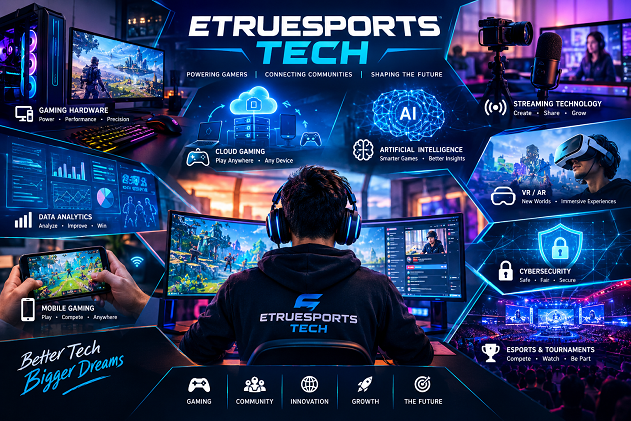
EtrueSports tech can be understood as a broad concept covering technology associated with gaming and esports. It includes gaming hardware, software, internet infrastructure, streaming technologies, artificial intelligence, virtual reality, cloud gaming, cybersecurity, and tools used to improve competitive performance.
The concept is not limited to a single device or technology. Instead, it describes an ecosystem in which multiple technologies work together. For example, a professional esports player may use a powerful gaming PC, a high-refresh-rate monitor, a low-latency mouse, a mechanical keyboard, a specialised headset, and a reliable internet connection. Behind the scenes, tournament organisers may use servers, broadcasting systems, statistical software, anti-cheat technologies, and communication platforms.
This technology ecosystem continues to evolve as manufacturers and developers introduce new products and services. As a result, staying informed about gaming technology has become increasingly important for anyone interested in competitive gaming.
Why Technology Matters in Esports
Technology plays a major role in determining how esports games are played, watched, and managed. In competitive environments, even small differences in response time or hardware performance can affect gameplay.
A high-refresh-rate monitor, for example, can provide smoother motion and make fast-moving objects easier to track. A responsive mouse can provide more precise control in competitive shooters. Similarly, stable internet connectivity helps reduce interruptions and latency during online matches.
Technology also supports fairness. Tournament organisers increasingly depend on secure servers, player authentication, anti-cheat systems, and monitoring tools to maintain competitive integrity. Without these systems, competitive gaming could become more vulnerable to cheating and technical problems.
For viewers, technology has made esports more accessible. Streaming platforms allow audiences around the world to watch competitions in real time, while statistics and interactive features provide additional information about teams and players.
Gaming Hardware and EtrueSports Tech
Gaming hardware is one of the most visible parts of the modern esports technology ecosystem. Players have access to an enormous range of devices designed for different genres and budgets.
Gaming PCs
A gaming PC remains one of the most flexible platforms for competitive gaming. A strong processor, capable graphics card, sufficient RAM, and fast storage can help games run smoothly at high frame rates.
For competitive players, consistent performance can be more important than simply purchasing the most expensive components. A balanced system should match the requirements of the games being played.
Gaming Monitors
Monitors are another important component. Standard displays may be adequate for casual gaming, while competitive players often prefer displays with high refresh rates and low response times.
A higher refresh rate can make gameplay appear smoother, particularly in fast-paced games. However, the benefit depends on the computer being capable of producing enough frames per second.
Gaming Keyboards and Mice
Input devices can significantly influence competitive performance. Mechanical keyboards are popular among many gamers because of their tactile feedback and responsiveness. Gaming mice may offer adjustable sensitivity, programmable buttons, ergonomic designs, and different sensor technologies.
The best device is not necessarily the most expensive one. Comfort, reliability, and personal preference are equally important.
Gaming Headsets
Audio can provide important information in competitive games. A quality headset can help players identify footsteps, gunfire, environmental sounds, and team communications.
Clear microphones are also valuable for team-based esports because effective communication can influence coordination and decision-making.
Internet Connectivity and Low Latency
Internet technology is one of the most important parts of online gaming. A player may own powerful hardware, but an unstable connection can still create a poor experience.
Latency, commonly measured in milliseconds, describes the delay involved in communication between a player’s device and the game server. Lower latency is generally desirable for competitive online gaming.
Connection stability is also important. Packet loss, jitter, and sudden disconnections can interfere with gameplay. For this reason, competitive players often pay close attention to their network setup.
Wired Ethernet connections can provide a more consistent connection than wireless networks in some environments. However, modern Wi-Fi technology can also provide excellent gaming performance when properly configured.
Artificial Intelligence in Gaming Technology
Artificial intelligence is becoming increasingly important across the gaming industry. AI can assist with game development, character behaviour, matchmaking, analytics, moderation, and player experiences.
Game developers can use AI-based systems to create more dynamic non-player characters and responsive environments. In esports, data analysis tools can help teams examine gameplay patterns and identify strengths and weaknesses.
AI may also assist with automated content moderation and fraud detection. As these technologies become more sophisticated, their role in gaming is likely to expand.
However, responsible implementation remains important. Developers and esports organisations need to consider privacy, fairness, transparency, and the potential misuse of automated systems.
Cloud Gaming and the Future of EtrueSports Tech
Cloud gaming represents another important technological development. Instead of requiring all game processing to happen on a player’s local device, cloud gaming can perform significant computing tasks on remote servers and stream the resulting gameplay to the player.
This approach may reduce the need for expensive hardware in certain situations. Players can potentially access demanding games using less powerful devices if they have a sufficiently strong internet connection.
However, cloud gaming also introduces challenges. Network latency, bandwidth requirements, server availability, and connection stability can all affect the experience.
For esports, extremely low latency is particularly important, meaning traditional local hardware may continue to have advantages for serious competitive play.
Virtual Reality and Augmented Reality
Virtual reality and augmented reality are also influencing gaming technology. VR can place players inside immersive digital environments using headsets and motion-tracking systems.
Although traditional esports remains dominated by conventional displays and input devices, VR could create new competitive gaming formats in the future.
Augmented reality offers another possibility by combining digital elements with the physical world. As hardware becomes smaller and more capable, these technologies may create new ways for audiences and players to interact with games.
Streaming Technology and Esports Broadcasting
Esports would not have reached its current global audience without streaming technology. Modern streaming allows competitions to reach viewers across multiple countries and devices.
Broadcasters can combine live gameplay with player statistics, instant replays, commentary, interviews, graphics, and real-time data. This creates a more engaging viewing experience.
Streaming technology has also created opportunities for individual creators. Gamers can broadcast their gameplay, build communities, interact with viewers, and develop careers around gaming content.
Reliable encoding, fast upload speeds, quality microphones, cameras, and broadcasting software are all important parts of a modern streaming setup.
Cybersecurity and Anti-Cheat Technology
As esports becomes more valuable, cybersecurity becomes increasingly important. Gaming accounts, tournament systems, payment platforms, and player information can all become targets for cyberattacks.
Strong passwords, multi-factor authentication, secure software, and regular updates can help protect users.
Anti-cheat technology is equally important in competitive gaming. Developers can use different detection and prevention systems to identify unauthorised software or suspicious behaviour.
No anti-cheat system is perfect, and technologies must continually evolve because cheating methods also change. Maintaining competitive integrity requires a combination of software, monitoring, rules, and enforcement.
Mobile Gaming Technology
Mobile gaming has expanded the reach of competitive gaming by allowing players to participate using smartphones and tablets.
Modern mobile devices can feature powerful processors, high-refresh-rate displays, advanced graphics capabilities, and improved cooling systems. Accessories such as gaming triggers, controllers, cooling fans, and specialised cases can further enhance the experience.
Mobile esports also benefits from widespread smartphone availability. Players do not necessarily need a desktop gaming setup to participate in competitive titles.
As mobile hardware continues improving, mobile gaming is likely to remain an important part of the wider etruesports tech landscape.
EtrueSports Tech and Player Performance
Technology can also help players understand and improve their performance. Modern games often collect detailed statistics, including accuracy, reaction-related metrics, movement patterns, win rates, damage statistics, and other performance indicators.
Players and coaches can analyse this information to identify areas for improvement.
For example, a team might review previous matches to understand positioning mistakes. An individual player may examine statistics to identify weaknesses in accuracy or decision-making.
Technology should therefore be viewed as a tool rather than a replacement for practice. Skill development still requires discipline, strategy, communication, and experience.
Key EtrueSports Tech Categories
| Technology Area | Main Purpose | Importance in Gaming |
|---|---|---|
| Gaming PC | Game processing and performance | Very High |
| Gaming Monitor | Visual clarity and smoothness | Very High |
| Keyboard & Mouse | Precise controls | High |
| Gaming Headset | Audio and communication | High |
| Internet | Online connectivity | Very High |
| AI | Analytics and automation | Growing |
| Cloud Gaming | Remote game processing | Growing |
| VR/AR | Immersive experiences | Emerging |
| Streaming | Broadcasting and content | Very High |
| Cybersecurity | Account and tournament protection | Very High |
| Anti-Cheat | Competitive integrity | Very High |
| Mobile Hardware | Portable gaming | High |
How to Choose the Right Gaming Technology
Choosing gaming technology should begin with understanding personal requirements rather than simply purchasing the newest products.
First, consider the games you play. A competitive shooter may require different hardware priorities from a strategy game or casual mobile title.
Second, establish a realistic budget. Spending more money does not automatically guarantee better performance. A balanced setup often provides better value.
Third, consider compatibility. Components and accessories should work properly with the intended gaming platform.
Finally, prioritise reliability and comfort. A device that feels comfortable and performs consistently can be more useful than an expensive product with features that are rarely used.
The Future of EtrueSports Tech
The future of gaming technology is likely to involve greater integration between hardware, software, artificial intelligence, cloud services, and digital communities.
AI-powered analytics may become more advanced, helping players and coaches understand gameplay at a deeper level. Cloud infrastructure may continue improving accessibility, while faster networks could reduce some limitations associated with remote gaming.
Hardware manufacturers are also likely to focus on efficiency, portability, display quality, and lower latency. Meanwhile, virtual and augmented reality could introduce new competitive experiences.
The esports industry itself is likely to become increasingly data-driven. Teams may use sophisticated analytics to evaluate players, develop strategies, and optimise training.
At the same time, cybersecurity and responsible technology use will remain critical. As more personal and competitive activity moves online, protecting users and maintaining fair competition will become even more important.
(FAQs): About EtrueSports Tech
1. What does etruesports tech mean?
EtrueSports tech is a broad term for technologies connected with modern gaming and esports, including hardware, software, networking, streaming, AI, cybersecurity, analytics, and emerging technologies.
2. Why is technology important in esports?
Technology supports competitive performance, online connectivity, tournament management, broadcasting, player analytics, communication, security, and anti-cheat systems.
3. What gaming hardware is most important?
For competitive gaming, a capable gaming system, responsive monitor, reliable input devices, good audio equipment, and stable internet connection are among the most important components.
4. Does expensive gaming hardware guarantee better performance?
No. Expensive equipment does not automatically make someone a better player. Skill, practice, game knowledge, teamwork, and strategy remain essential.
5. How does AI affect gaming?
AI can support game development, non-player characters, analytics, matchmaking, moderation, personalisation, and other gaming-related processes.
6. Is cloud gaming suitable for esports?
Cloud gaming can be useful for accessibility, but competitive esports often requires extremely low latency and consistent performance. Local hardware may therefore remain preferable for serious competition.
7. Why is internet latency important?
Low latency helps reduce communication delays between the player’s device and the game server, which can be particularly important in fast-paced competitive games.
8. What is the future of esports technology?
Future developments are likely to include more advanced AI analytics, faster networks, improved gaming hardware, cloud services, immersive technologies, mobile gaming innovations, and stronger cybersecurity.
9. Can mobile gaming be considered esports?
Yes. Mobile games can support organised competitive tournaments, professional teams, spectators, streaming, rankings, and other characteristics associated with esports.
10. How can gamers keep up with gaming technology?
Gamers can follow reliable gaming technology news, compare product specifications, learn about new software and hardware, and focus on technologies that directly benefit their preferred games and playing style.
Conclusion: EtrueSports Tech
EtrueSports tech represents the growing relationship between technology, gaming, and esports. From gaming PCs and high-refresh-rate monitors to artificial intelligence, cloud gaming, streaming, cybersecurity, and mobile devices, technology influences nearly every part of the modern gaming experience.
Understanding technology can help the casual gamer build better and more enjoyable setups. For competitive players, it can offer tools to enhance performance and remain consistent. For esports organisations, technology underpins tournaments, broadcasting, analytics, security and engaging a global audience.
The most important lesson is that technology works best when it serves the player’s needs. Instead of chasing every new product, gamers should focus on performance, reliability, compatibility, comfort, and value.
As gaming continues to develop, new innovations will undoubtedly change how people play, compete, watch, and interact. Keeping an eye on etruesports tech and broader gaming technology trends can help players and enthusiasts understand these changes and prepare for the future.
About the Author