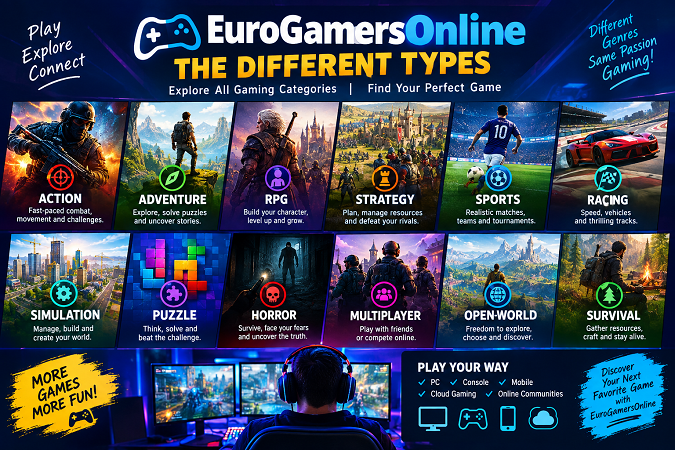
EuroGamersOnline The Different Types
The gaming world has become more diverse than ever. Players can now choose from thousands of games across computers, consoles, smartphones, tablets, and online platforms. From fast-paced competitive experiences to relaxing strategy games, there is something available for almost every type of player. Understanding these categories can make it easier to discover games that match individual interests, preferred play styles, and available devices.The phrase “eurogamersonline the different types” can be used to explore the broad range of gaming experiences associated with online gaming communities and digital entertainment. Rather than focusing on one specific title, it is useful to look at the different types of games players commonly encounter. Each category offers different mechanics, objectives, challenges, and social experiences.
This guide explains the major types of games, how they differ, what makes them popular, and what players should consider when choosing a new gaming experience.
Also Read: Gaming News EteSportech from ETrueSports
What Does EuroGamersOnline the Different Types Mean?
The concept behind eurogamersonline the different types is essentially about understanding the variety of games available to modern players. Online gaming is no longer limited to a particular genre or device. A player might enjoy an action game in the morning, participate in a multiplayer strategy match later, and play a casual puzzle game before going to sleep.
Gaming categories are generally identified by their core mechanics and the type of experience they provide. Some games emphasise competition, while others prioritise exploration, storytelling, creativity, problem-solving, or social interaction.
Learning these categories can help new players understand gaming terminology and allow experienced players to discover genres they may not have previously explored.
Different Types of Games Available Online
1. Action Games
Action games are among the most recognisable gaming categories. They usually emphasise quick reactions, movement, combat, timing, and coordination. Players may need to defeat opponents, avoid obstacles, complete missions, or survive challenging environments.
Action games can include platformers, fighting games, hack-and-slash titles, and other experiences where immediate player input is important.
These games are particularly attractive to players who enjoy fast gameplay and continuous challenges. Difficulty can range from simple controls designed for beginners to complex systems intended for experienced players.
2. Adventure Games
Adventure games focus more heavily on exploration, discovery, storytelling, and interaction with virtual environments. Instead of relying entirely on combat, these games may ask players to investigate locations, communicate with characters, collect objects, or solve environmental problems.
Many modern adventure games combine elements from other genres. For example, an adventure title may include action sequences, puzzles, role-playing mechanics, or open-world exploration.
The appeal of adventure games often comes from their ability to create a sense of discovery. Players can become involved in fictional worlds and follow stories that develop over many hours.
3. Role-Playing Games
Role-playing games, commonly known as RPGs, allow players to control characters who develop throughout a game. Character progression can include improved abilities, equipment, skills, statistics, and new powers.
RPGs often feature quests, conversations, exploration, and decision-making. Some titles offer highly detailed worlds where players can spend dozens or even hundreds of hours.
There are several subcategories within RPGs, including action RPGs, tactical RPGs, massively multiplayer online role-playing games, and turn-based RPGs.
For players who enjoy progression and customisation, RPGs can provide a particularly deep experience.
4. Strategy Games
Strategy games require players to think carefully about resources, positioning, planning, and long-term decisions. Instead of depending primarily on reaction speed, success often depends on making effective choices.
Strategy games can be divided into several formats. Real-time strategy games allow decisions to happen continuously, while turn-based strategy games give players time to consider their next move.
Other strategy experiences may focus on managing civilisations, building armies, controlling resources, or developing economies.
These games can appeal to players who enjoy planning and problem-solving.
5. Simulation Games
Simulation games attempt to recreate real-world or imaginary activities. They can cover subjects such as driving, flying, farming, city management, business, construction, or everyday life.
One of the main attractions of simulation games is freedom. Players may be able to create their own goals instead of following a fixed storyline.
For example, a city-building simulation might allow a player to design roads, manage resources, and expand a virtual community. A life simulation could allow players to control characters and make decisions about their virtual lives.
6. Sports Games
Sports games bring activities such as football, basketball, racing, tennis, and other competitions into digital environments.
Many sports games provide single-player modes, local multiplayer, online competitions, career modes, and team-management features.
Sports titles are especially popular among players who already follow real-world sports. They can offer a combination of familiar teams, competitive mechanics, and strategic decision-making.
Online multiplayer has also expanded the social side of sports gaming, allowing players to compete against people in different locations.
7. Racing Games
Racing games focus on speed, vehicles, tracks, and competition. They range from realistic driving simulations to arcade-style experiences.
Simulation-orientated racing games may emphasise vehicle handling, braking, tyre management, track conditions, and realistic physics. Arcade racers generally focus on accessibility, speed, special abilities, and entertaining gameplay.
Racing games are often suitable for both casual and competitive players because they can provide short sessions as well as long-term progression.
8. Puzzle Games
Puzzle games challenge players to identify patterns, solve problems, organise objects, or find logical solutions.
They are available across almost every gaming platform, including smartphones and web browsers. Because many puzzle games have relatively simple controls, they are accessible to a broad audience.
Puzzle games can also vary considerably in complexity. Some are designed for quick five-minute sessions, while others present increasingly difficult challenges that require careful reasoning.
9. Multiplayer Online Games
Multiplayer games allow several players to interact within the same digital environment. Depending on the title, players may cooperate, compete, communicate, or participate in large online communities.
Online multiplayer games can include shooters, RPGs, strategy games, sports games, racing games, and many other genres.
The social element is one of their biggest attractions. Players can form teams, join communities, communicate through supported features, and develop competitive skills.
However, players should always consider online safety, privacy settings, account security, and responsible gaming habits.
10. Battle Royale Games
Battle royale games combine survival, exploration, resource collection, and competition. Players typically enter a large map and compete until a final player or team remains.
A major feature of this category is the shrinking playable area found in many titles. This gradually brings players closer together and increases the intensity of matches.
Battle royale games have become a significant part of modern multiplayer gaming because they can combine short-term excitement with long-term progression and competitive play.
11. First-Person Shooter Games
First-person shooters, or FPS games, present gameplay from the character’s first-person perspective. They commonly involve weapons, movement, objectives, teamwork, and competitive matches.
Some FPS games focus on realistic military scenarios, while others use fictional worlds and unusual abilities.
Online FPS games can require communication and teamwork. Players may need to understand maps, coordinate with teammates, manage resources, and react quickly to opponents.
12. Casual Games
Casual games are designed to be easy to understand and often require relatively little time to begin playing.
Mobile gaming has contributed significantly to the popularity of this category. Casual games can include puzzles, card games, simple arcade experiences, word games, and short strategy challenges.
Their accessibility makes them useful for people who want entertainment without committing to long gaming sessions.
Why Are There So Many Different Types of Games?
The gaming industry serves a huge international audience with different interests and expectations. Some players want competitive experiences, while others prefer stories or creativity.
Technology has also expanded the possibilities. Modern computers and consoles can support highly detailed virtual worlds, while smartphones make gaming accessible almost anywhere.
Online connectivity has introduced another dimension. Games can now support large communities, regular updates, competitions, downloadable content, and social features.
As a result, genres increasingly overlap. A single game might combine role-playing, action, strategy, exploration, and multiplayer elements rather than fitting neatly into one category.
Comparing Different Gaming Types: EuroGamersOnline the Different Types
| Game Type | Main Focus | Typical Experience | Suitable For |
|---|---|---|---|
| Action | Reflexes and combat | Fast-paced | Players who enjoy quick challenges |
| Adventure | Exploration and story | Discovery-focused | Story and exploration fans |
| RPG | Character progression | Long-term development | Players who enjoy customisation |
| Strategy | Planning and decisions | Tactical | Problem-solving players |
| Simulation | Realistic or creative activities | Open-ended | Creative and management-focused players |
| Sports | Athletic competition | Competitive | Sports enthusiasts |
| Racing | Speed and driving | Competitive | Vehicle and racing fans |
| Puzzle | Logic and problem-solving | Mental challenge | Casual and analytical players |
| Multiplayer | Social competition/cooperation | Interactive | Community-orientated players |
| Battle Royale | Survival and competition | High intensity | Competitive players |
| FPS | Shooting and teamwork | Fast-paced | Competitive action fans |
| Casual | Simple entertainment | Short sessions | Beginners and casual players |
How to Choose the Right Type of Game: EuroGamersOnline the Different Types
Choosing a game does not have to be complicated. The best starting point is to identify what kind of experience you want.
If you enjoy stories and exploration, adventure or RPG games may be interesting. If you prefer competition, sports, racing, FPS, or battle royale games can provide competitive environments.
Players who prefer thinking and planning may enjoy strategy and puzzle games. Meanwhile, simulation games can be appealing if creativity, construction, management, or realistic activities are more interesting.
Device compatibility is another important consideration. Not every game is available on every platform, and some games require more powerful hardware than others.
Internet requirements should also be considered. Single-player games may work without a constant connection, while many multiplayer experiences depend heavily on stable internet access.
Online Gaming and Social Interaction: EuroGamersOnline the Different Types
Modern gaming is increasingly social. Multiplayer platforms can connect people from different countries and allow them to cooperate or compete.
Communication tools can make teamwork easier, particularly in strategy games and competitive multiplayer titles. Gaming communities can also exist through forums, streaming platforms, social networks, and dedicated discussion groups.
However, online interaction should be approached responsibly. Players should avoid sharing sensitive personal information, use strong passwords, enable available security features, and report inappropriate behaviour through platform tools when necessary.
Gaming Platforms and Accessibility: EuroGamersOnline the Different Types
Games are available on a wide range of platforms, including PCs, consoles, smartphones, tablets, and web-based services.
PC gaming often provides extensive customisation and hardware options. Consoles offer dedicated gaming environments with standardised hardware. Mobile devices provide convenience because players can access games while away from traditional gaming setups.
Cloud-based gaming and other emerging technologies may further expand access to digital games, although availability and performance depend on internet infrastructure and service support.
The Importance of Responsible Gaming: EuroGamersOnline the Different Types
Gaming can be an enjoyable form of entertainment, but balance is important. Players should take regular breaks, maintain healthy sleep habits, and avoid allowing gaming to interfere with education, employment, relationships, or other responsibilities.
Parents and guardians may also want to review age ratings, privacy settings, spending controls, and communication options for younger players.
Responsible gaming is not about avoiding games completely. It is about making gaming fit comfortably into a balanced lifestyle.
Future Trends in Different Types of Gaming: EuroGamersOnline the Different Types
The future of gaming is likely to continue bringing different genres together. Artificial intelligence, improved graphics, faster networks, virtual reality, augmented reality, and cloud technologies are influencing how games are developed and played.
Virtual and augmented reality may create more immersive experiences. Artificial intelligence can help developers create dynamic characters and environments. Meanwhile, online platforms can continue expanding social and competitive experiences.
Rather than replacing traditional genres, these technologies may add new features to existing categories.
(FAQs): About EuroGamersOnline the Different Types
What does “eurogamersonline the different types” refer to?
The phrase can be used as a search topic for exploring different categories and styles of online and digital gaming, including action, adventure, RPG, strategy, simulation, sports, racing, puzzle, and multiplayer games.
What are the main types of video games?
Common categories include action, adventure, role-playing, strategy, simulation, sports, racing, puzzle, shooter, battle royale, multiplayer, and casual games.
Which gaming type is suitable for beginners?
Casual and puzzle games can be approachable for beginners because many offer simple controls and easy-to-understand objectives. However, the right choice depends on personal interests.
Are RPG games always multiplayer?
No. RPGs can be completely single-player, multiplayer, or a combination of both. The defining feature of an RPG is generally character progression and role-playing mechanics rather than multiplayer functionality.
What is the difference between action and strategy games?
Action games commonly emphasise reflexes, movement, and immediate responses, while strategy games generally emphasise planning, resource management, positioning, and decision-making.
Are simulation games realistic?
Some simulation games aim for realism, while others use simulation mechanics for creative or entertaining experiences. The level of realism varies significantly between titles.
Can one game belong to multiple categories?
Yes. Modern games frequently combine genres. For example, a title may combine action, RPG progression, open-world exploration, and multiplayer features.
Why are online multiplayer games popular?
They allow players to compete or cooperate with other people, creating social and competitive experiences that can change from one match or session to another.
What should I consider before choosing an online game?
Consider the genre, gameplay style, device requirements, internet requirements, age rating, cost, available features, and whether you prefer single-player, cooperative, or competitive gameplay.
Is gaming suitable for everyone?
Gaming is a broad form of entertainment with experiences designed for different audiences. Players should consider age ratings, accessibility features, personal preferences, and responsible time management when choosing games.
Conclusion: EuroGamersOnline the Different Types
Understanding eurogamersonline the different types provides a useful starting point for exploring the broad world of modern gaming. From action and adventure to RPGs, strategy, simulation, sports, racing, puzzles, multiplayer games, and casual experiences, every category offers a different way to interact with digital entertainment.
There is no single gaming type that suits everyone. Personal interests, preferred difficulty, available time, device compatibility, and interest in competition or storytelling can all influence which category feels most enjoyable.
The most useful approach is to explore different genres gradually. Trying unfamiliar categories can introduce players to new mechanics, communities, stories, and challenges. As gaming technology continues to evolve, the boundaries between genres will likely become even less defined, creating increasingly varied experiences for players around the world.
About the Author