What Is Day Trading
Day trading has become one of the most talked-about ways to participate in financial markets. With the rise of commission-free brokers, real-time trading platforms, and easy access to stocks, cryptocurrencies, forex, and options, more people than ever are curious about how day trading works.
But before risking your money, it’s important to understand exactly what day trading is, why people do it, and the challenges involved. While some traders earn consistent profits, many beginners lose money because they jump in without enough knowledge, discipline, or risk management.
This guide explains everything you need to know about day trading in simple language. Whether you’re completely new to trading or looking to understand the basics before opening a brokerage account, you’ll learn how day trading works, the markets you can trade, the skills required, and what separates successful traders from unsuccessful ones.
What Is Day Trading?
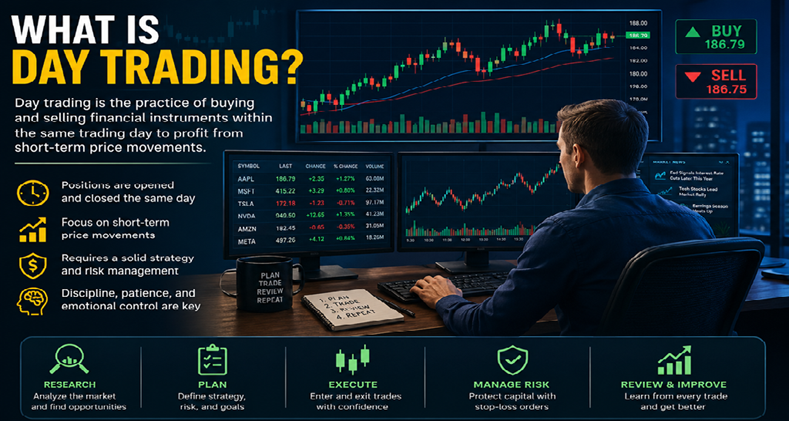
Day trading is the practice of buying and selling financial assets within the same trading day. The goal is to profit from short-term price movements rather than holding investments for months or years.
A day trader opens a position and closes it before the market closes. This means they typically do not keep trades overnight, reducing exposure to after-hours news and unexpected market events.
Unlike long-term investors who focus on company growth over many years, day traders aim to take advantage of small price fluctuations that happen throughout the day.
These financial assets may include:
- Stocks
- Exchange-Traded Funds (ETFs)
- Forex currencies
- Cryptocurrencies
- Futures contracts
- Options
The main objective is simple:
Buy low, sell high—or sell high first (short selling) and buy back lower—within the same trading session.
How Does Day Trading Work?
Day trading involves making quick decisions based on stock market terminology movements. Instead of waiting months for an investment to grow, traders may hold a position for only a few minutes or even seconds.
A typical day trader follows this process:
| Step | Description |
|---|---|
| Market Research | Review news, earnings, and economic events. |
| Watchlist | Select stocks or assets showing strong movement. |
| Market Analysis | Study charts and technical indicators. |
| Entry | Buy or sell when trading conditions match the strategy. |
| Risk Management | Set stop-loss and profit targets. |
| Exit | Close the position before the trading session ends. |
| Review | Analyze completed trades to improve future performance. |
Professional traders repeat this process every trading day.
Example of a Day Trade
Imagine a stock opens at $50.00.
A trader notices strong buying pressure after positive company news.
The trader buys:
- 100 shares at $50.00
Within an hour, the stock rises to:
- $50.80
The trader sells all shares.
Calculation
Purchase Price:
100 × $50 = $5,000
Selling Price:
100 × $50.80 = $5,080
Gross Profit:
$80
This example shows how day traders aim to earn small gains repeatedly instead of waiting for large long-term returns.
Key Features of Day Trading
Several characteristics make day trading different from investing.
Positions Are Closed Daily
One defining feature is that positions are usually closed before the market closes.
This reduces exposure to:
- Overnight news
- Earnings surprises
- Political events
- Global market gaps
High Trading Frequency
Many day traders place multiple trades in one day.
Some may execute:
- 3–5 trades daily
- 10–20 trades daily
- Hundreds of trades using automated systems
The frequency depends on the trader’s strategy and experience.
Heavy Use of Technical Analysis
Most day traders rely on technical analysis instead of long-term company fundamentals.
They study:
- Price charts
- Candlestick patterns
- Volume
- Moving averages
- RSI
- MACD
- VWAP
- Support and resistance levels
The objective is to identify short-term trading opportunities.
Strict Risk Management
Successful traders understand that protecting capital is more important than making huge profits.
Common risk management techniques include:
- Stop-loss orders
- Position sizing
- Daily loss limits
- Risk-to-reward ratios
- Diversification across trades
Without proper risk management, even experienced traders can suffer significant losses.
Types of Markets for Day Trading
One advantage of day trading is the variety of markets available.
Stock Market
Stock day trading involves buying and selling shares of publicly traded companies.
Popular stocks usually include:
- Technology companies
- Healthcare companies
- Energy companies
- Financial institutions
Traders prefer stocks with:
- High liquidity
- Strong trading volume
- Significant daily price movement
Forex Market
Forex trading involves exchanging one currency for another.
Examples include:
- EUR/USD
- GBP/USD
- USD/JPY
- AUD/USD
The forex market operates nearly 24 hours a day during the business week, making it attractive to traders in different time zones.
Cryptocurrency Market
Cryptocurrency day trading has become increasingly popular because digital assets trade 24/7.
Common cryptocurrencies include:
- Bitcoin (BTC)
- Ethereum (ETH)
- Solana (SOL)
- XRP
- BNB
Crypto markets are known for higher volatility, which can create both opportunities and increased risk.
Futures Market
Futures contracts allow traders to speculate on the future price of assets such as:
- Gold
- Oil
- Natural Gas
- Stock indexes
- Agricultural products
Professional traders often choose futures because of their liquidity and leverage.
Options Market
Options provide the right—but not the obligation—to buy or sell an asset at a predetermined price before a specified expiration date.
Many experienced traders use options for:
- Short-term speculation
- Hedging
- Income strategies
However, options involve additional complexity and are generally better suited to traders who understand their risks and pricing.
Who Can Become a Day Trader?
Technically, anyone with access to a brokerage account and sufficient funds can learn day trading.
However, successful day traders typically possess certain qualities.
Discipline
Following a trading plan without acting on emotion is essential. Discipline helps traders avoid impulsive decisions that can lead to unnecessary losses.
Patience
Not every day offers good trading opportunities.
Experienced traders often wait for high-probability setups rather than forcing trades.
Emotional Control
Fear and greed are two of the biggest obstacles in trading.
Successful traders stick to their strategy whether they experience wins or losses.
Analytical Thinking
Day traders constantly interpret:
- Price action
- Volume
- Market trends
- News events
- Technical indicators
Strong analytical skills help traders make informed decisions quickly.
Willingness to Learn
Financial markets evolve continuously.
Successful traders spend time:
- Studying charts
- Reviewing trades
- Reading market news
- Testing strategies
- Improving their trading plans
Continuous learning is one of the defining characteristics of long-term trading success.
Why People Choose Day Trading
Day trading attracts people from different backgrounds because it offers the possibility of generating income from short-term market movements. Some pursue it as a full-time career, while others trade part-time alongside another job.
However, it’s important to remember that day trading is not a guaranteed way to make money. It requires education, practice, discipline, and a well-defined trading plan.
Some of the most common reasons people choose day trading include:
- Potential for daily profit opportunities
- No overnight market exposure
- Ability to trade from anywhere with an internet connection
- Access to multiple financial markets
- Flexible work schedule
- Opportunity to be self-employed
While these advantages are appealing, they also come with significant risks that every beginner should understand.
Advantages of Day Trading
Day trading offers several benefits when approached responsibly.
1. Daily Trading Opportunities
Financial markets create price movements every day. Whether markets are rising or falling, traders may find opportunities if they understand how to analyze price action.
Unlike long-term investing, traders don’t have to wait months or years to potentially realize gains.
2. No Overnight Risk
One of the biggest advantages is closing all positions before the market ends.
This helps traders avoid unexpected events such as:
- Earnings announcements
- Economic reports
- Political developments
- Natural disasters
- Global market news
These events can cause prices to gap sharply when markets reopen.
3. Immediate Feedback
Because trades are completed quickly, traders receive fast feedback on whether their strategy worked.
This allows continuous improvement through trade analysis and journaling.
4. High Liquidity
Many day traders focus on highly liquid markets.
High liquidity generally means:
- Faster order execution
- Smaller bid-ask spreads
- Easier entry and exit
- Lower slippage
5. Multiple Markets to Choose From
A trader isn’t limited to one asset class.
Depending on their interests, they can trade:
| Market | Trading Hours | Volatility | Beginner Friendly |
|---|---|---|---|
| Stocks | Market hours | Medium | Yes |
| Forex | Nearly 24/5 | Medium | Yes |
| Cryptocurrency | 24/7 | High | Moderate |
| Futures | Extended hours | High | Moderate |
| Options | Market hours | High | Advanced |
Risks of Day Trading
While day trading offers opportunities, it also involves considerable risk. Understanding these risks is essential before committing real money.
1. High Probability of Losses
Many beginners lose money because they:
- Trade without a plan
- Ignore risk management
- Overtrade
- Let emotions drive decisions
Successful trading requires consistency rather than chasing quick profits.
2. Emotional Pressure
Day trading can be mentally demanding.
Common emotional challenges include:
- Fear of missing out (FOMO)
- Panic selling
- Revenge trading after losses
- Overconfidence after winning streaks
Managing emotions is just as important as analyzing charts.
3. Market Volatility
Prices can change rapidly due to:
- Breaking news
- Economic data
- Company announcements
- Unexpected global events
High volatility creates opportunity but also increases risk.
4. Leverage Risk
Many brokers offer leverage, allowing traders to control larger positions with less capital.
For example:
Without leverage:
$5,000 buys $5,000 worth of stock.
With 5:1 leverage:
$5,000 controls $25,000 worth of stock.
While leverage can amplify gains, it also magnifies losses. Beginners should use leverage cautiously, if at all.
5. Transaction Costs
Although many brokers advertise commission-free trading, other costs may still apply, such as:
- Bid-ask spreads
- Exchange fees
- Regulatory fees
- Margin interest
- Currency conversion fees
Frequent trading can make these costs add up over time.
Essential Tools for Day Trading
Professional traders rely on a combination of technology, market data, and analytical tools.
Trading Platform
A reliable trading platform allows users to:
- Place orders quickly
- Monitor positions
- Analyze charts
- Set stop-loss orders
- Track performance
Key features include speed, stability, and user-friendly design.
Real-Time Market Data
Successful day trading depends on current information.
Real-time data provides:
- Live prices
- Trading volume
- Bid and ask quotes
- Market depth
- News updates
Delayed data can lead to poor trading decisions.
Charting Software
Charts help traders identify trends and potential entry or exit points.
Common chart types include:
- Line charts
- Bar charts
- Candlestick charts
- Heikin Ashi charts
- Renko charts
Candlestick charts are among the most widely used because they display detailed price action within a selected time frame.
Technical Indicators
Technical indicators assist traders in analyzing market momentum and trends.
Popular indicators include:
| Indicator | Purpose |
|---|---|
| Moving Average | Identifies trend direction |
| RSI | Measures momentum and overbought/oversold conditions |
| MACD | Detects trend changes |
| VWAP | Tracks average price weighted by volume |
| Bollinger Bands | Measures volatility |
| Stochastic Oscillator | Highlights potential reversals |
| ATR | Estimates market volatility |
No single indicator is perfect, so traders often combine several tools to confirm trade setups.
Popular Day Trading Strategies
Different traders use different approaches depending on their goals, experience, and risk tolerance.
Scalping
Scalping involves making many small trades throughout the day.
Typical characteristics include:
- Holding trades for seconds or minutes
- Targeting small price movements
- High trading frequency
- Strict risk management
Scalping requires quick decision-making and fast execution.
Momentum Trading
Momentum traders look for assets experiencing strong upward or downward price movement.
They often enter trades after:
- Breaking news
- Earnings reports
- High trading volume
- Price breakouts
The goal is to ride the momentum before it fades.
Breakout Trading
Breakout traders wait for prices to move beyond key support or resistance levels.
A breakout may signal:
- The start of a new trend
- Increased buying pressure
- Increased selling pressure
Volume confirmation is commonly used to validate breakouts.
Pullback Trading
Instead of buying at the highest price, pullback traders wait for a temporary retracement within an existing trend.
For example:
- Price moves upward.
- It pulls back slightly.
- The trader enters if the broader trend remains intact.
This approach can provide more favorable entry prices.
Range Trading
Range trading works best when prices move sideways between established support and resistance levels.
Traders aim to:
- Buy near support
- Sell near resistance
This strategy is generally less effective during strong trending markets.
Risk Management Techniques
Protecting trading capital is the foundation of long-term success. Even experienced traders expect losses and focus on keeping them manageable.
Always Use a Stop-Loss
A stop-loss order automatically closes a trade if the price reaches a predetermined level.
Benefits include:
- Limiting potential losses
- Removing emotional decision-making
- Protecting trading capital
Every trade should have a planned exit before it is entered.
Risk Only a Small Percentage Per Trade
Many experienced traders avoid risking a large portion of their account on a single trade.
A common guideline is to risk only a small percentage of total capital on each position. This helps preserve capital during losing streaks and supports long-term consistency.
Maintain a Favorable Risk-to-Reward Ratio
Before entering a trade, compare the potential reward with the amount you’re willing to risk.
For example:
- Risk: $100
- Target profit: $300
This creates a 1:3 risk-to-reward ratio, meaning one successful trade can offset multiple smaller losses.
Keep a Trading Journal
Recording every trade can help identify patterns and improve decision-making over time.
Include details such as:
- Entry and exit prices
- Trade size
- Strategy used
- Reason for entering the trade
- Outcome
- Lessons learned
Reviewing this journal regularly can highlight strengths and areas for improvement.
Common Mistakes Beginner Day Traders Make
Nearly every new trader makes mistakes during the learning process. The difference between successful and unsuccessful traders often comes down to recognizing these mistakes early and correcting them.
1. Trading Without a Plan
Many beginners enter trades based on emotions, social media tips, or market hype instead of following a structured trading strategy.
A good trading plan should define:
- Entry conditions
- Exit strategy
- Stop-loss placement
- Profit target
- Position size
- Maximum daily loss
Without a plan, it’s easy to make inconsistent decisions.
2. Ignoring Risk Management
Trying to recover losses by increasing trade size is one of the fastest ways to damage a trading account.
Successful traders focus on protecting capital before thinking about profits.
Remember:
Capital preservation comes first.
3. Overtrading
Overtrading happens when traders take too many trades, often because they:
- Feel bored
- Want to recover losses
- Become overconfident after winning
Quality setups are more important than quantity.
Sometimes, the best trade is not trading at all.
4. Letting Emotions Control Decisions
Markets can trigger powerful emotions.
Common emotional mistakes include:
- Fear of missing out (FOMO)
- Panic selling
- Holding losing positions too long
- Selling winning trades too early
Developing emotional discipline is one of the most valuable skills a trader can build.
5. Using Too Much Leverage
Leverage can increase buying power, but it also increases risk.
Many beginners focus on potential profits without fully understanding how quickly leveraged losses can accumulate.
Learning to trade consistently without relying on high leverage is often a more sustainable approach.
How to Start Day Trading as a Beginner
If you’re interested in day trading, following a structured learning path can help reduce costly mistakes.
Step 1: Learn the Basics
Start by understanding:
- Market structure
- Order types
- Technical analysis
- Risk management
- Trading psychology
Build a solid foundation before risking money.
Step 2: Choose a Reliable Broker
Look for a broker that offers:
- Competitive fees
- Fast trade execution
- A stable trading platform
- Real-time market data
- Educational resources
- Responsive customer support
Research regulations and account requirements in your country before opening an account.
Step 3: Practice with a Demo Account
A demo account lets you trade using virtual funds in a simulated market environment.
Benefits include:
- Learning the platform
- Testing strategies
- Building confidence
- Practicing risk management
While demo trading doesn’t replicate every aspect of live trading, it’s a useful way to gain experience before using real money.
Step 4: Develop a Trading Strategy
Your strategy should answer questions like:
- What market will I trade?
- What time of day will I trade?
- What conditions trigger an entry?
- Where will I place my stop-loss?
- What is my profit target?
- How much capital will I risk?
Write your strategy down and follow it consistently.
Step 5: Start Small
Avoid risking a large amount of money at the beginning.
Start with small position sizes while you gain experience.
Focus on consistency rather than trying to earn large profits quickly.
Step 6: Review Every Trade
Continuous improvement is one of the hallmarks of successful traders.
After each trading session, review:
- What worked well?
- What mistakes were made?
- Did you follow your plan?
- Were emotions involved?
- How can you improve next time?
Small improvements made consistently can lead to better long-term performance.
Day Trading vs. Investing
Although both involve the financial markets, day trading and investing have different goals and time horizons.
| Feature | Day Trading | Long-Term Investing |
|---|---|---|
| Holding Period | Minutes to one day | Months to years |
| Primary Goal | Profit from short-term price movements | Build long-term wealth |
| Analysis | Primarily technical analysis | Primarily fundamental analysis |
| Trading Frequency | High | Low |
| Risk Level | Generally higher | Generally lower (depending on the investment) |
| Time Commitment | Several hours daily | Minimal ongoing monitoring |
| Overnight Positions | Usually avoided | Common |
Choosing between day trading and investing depends on your financial goals, available time, risk tolerance, and experience.
Is Day Trading Profitable?
This is one of the most frequently asked questions by beginners.
The honest answer is:
Yes, day trading can be profitable—but it is also risky, and profitability is far from guaranteed.
Consistent profitability typically requires:
- Extensive education
- Continuous practice
- Strong discipline
- Effective risk management
- Emotional control
- A tested trade strategy
Many beginners experience losses while learning. Successful traders generally focus on refining their process rather than chasing quick profits.
It’s also important to remember that past performance does not guarantee future results.
(FAQs)
What is day trading in simple words?
Day trading is the practice of buying and selling financial assets within the same trading day to try to profit from short-term price movements.
Is day trading legal?
In most countries, day trading is legal when conducted through a licensed brokerage and in accordance with local laws and regulations. Be sure to understand the rules that apply where you live.
How much money do I need to start day trading?
The required amount depends on the market you choose, your broker’s requirements, and local regulations. Some brokers allow small accounts, while others have higher minimum balances or additional rules for frequent traders.
Can beginners learn day trading?
Yes. Beginners can learn day trade through education, practice, and experience. Starting with a demo account and using sound risk management can help build confidence before trade with real money.
Is day trading the same as investing?
No. Day trade focuses on short-term price movements and usually closes positions within the same day, while investing typically involves holding assets for months or years based on long-term growth expectations.
Which market is best for beginners?
Many beginners start with highly liquid stocks or major forex currency pairs because they are widely traded and generally have abundant educational resources. The best choice depends on your goals, available capital, and understanding of the market.
Can I day trade part-time?
Yes. Some traders participate only during specific market sessions or for a few hours each day. Success depends more on preparation, discipline, and strategy than on the number of hours spent trade.
Do I need technical analysis?
Most day traders rely on technical analysis because they focus on short-term price action. However, understanding market news and broader economic events can also be valuable.
Final Thoughts
Understanding what is day trade is the first step toward deciding whether this fast-paced approach to the financial markets is right for you. Day trade involves buying and selling assets within the same trade day, with the aim of profiting from short-term price movements. While the potential for profit attracts many people, it also comes with significant risks that require careful preparation.
Success in day trade is rarely about luck. It comes from developing a solid strategy, practicing consistently, managing risk effectively, and maintaining emotional discipline. Traders who focus on education, patience, and continuous improvement are generally better positioned to navigate changing market conditions.
If you’re just starting, take the time to learn the fundamentals, practice with a demo account, and avoid risking money you cannot afford to lose. Building skills gradually is often more valuable than chasing quick profits.
About the Author